Transylvania's fortified churches face fragile future / Photo: Daniel MIHAILESCU - AFP
 16°C
16°C
Built in the Middle Ages to provide shelter from attacks, Transylvania's fortified churches risk crumbling despite efforts to preserve and breathe new life into them.
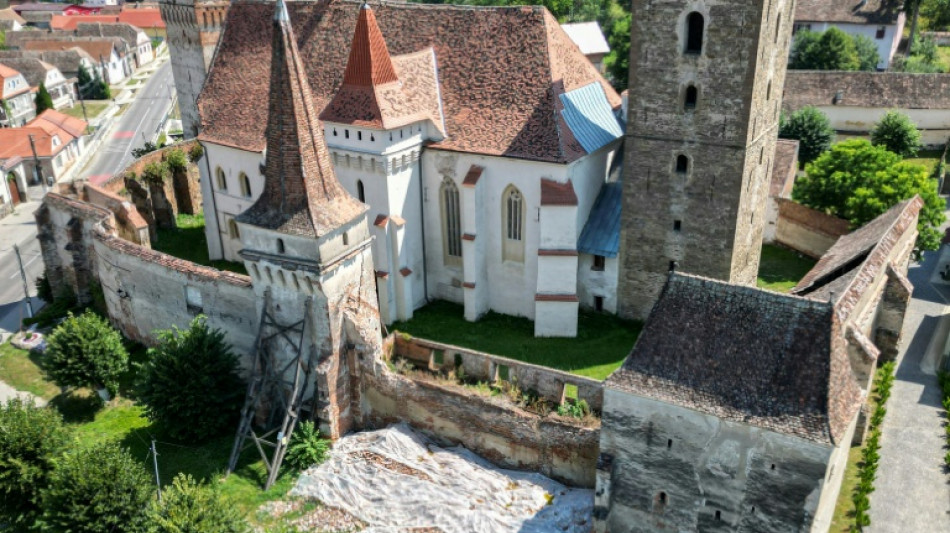
In a stark reminder, the outer wall of a historic church in the village of Mosna in central Romania -- visited by Britain's King Charles III in 1998 -- collapsed one night in June.
Since then, Mariana Rempler, the village's last woman from the German-speaking Saxon minority, lives in fear that the church -- which attracts 4,000 visitors a year -- could also lose one of its towers.
"I felt a great pain inside me. It was as if I had collapsed at the same time with that wall," the 74-year-old told AFP, recalling the incident with tears in her eyes inside the church where she herself was baptised and wed.
Mosna is one of the over 160 churches fortified with outer walls in Transylvania, built by the German minority so that the population in the then disputed border territory could take refuge from Tatars and Ottomans.
As the Saxons left Romania, many to escape the communist dictatorship of Nicolae Ceausescu, several churches deteriorated with no one left to look after them.
They are among historic monuments and other buildings in the eastern European country -- one of the continent's poorest -- to fall victim to neglect and decay.
- 'New concept for survival' -
Even edifices like Mosna, which underwent renovation after the fall of communism in 1989, remain in danger, with funds for more work difficult to find.
Out of the 300,000 Saxons that lived in Transylvania before World War II, only about 10,000 remain today.
About half of all fortified churches -- around 80, including Mosna -- have undergone restoration work in the last 35 years or will do over the next five years, Cristian Cismaru, manager at the Fortified Churches Foundation, told AFP.
The foundation works with the Evangelical Church in Romania to preserve the historic monuments with grants and donations. Some 85 percent of the money comes from the European Union.
"I don't think we'll be able to address the other half of our heritage in our lifetime. That will be left for future generations," Cismaru told AFP at a brunch he organised with the local community for tourists, followed by a tour of the church in the village of Cincsor, 60 kilometres (40 miles) southeast of Mosna.
He explained to participants that a third of the 30-euro ($35) entry ticket would be donated to a local development project.
"Our role, those of us who live in Transylvania, regardless of nationality, race or religion, is to continue to look after these monuments," he said.
"We want to breathe new life into these fortified churches."
Cismaru added that many of the churches need "a new concept for their survival", since they can no longer function just as places of worship. One proposal is to turn them into cultural spaces.
Earlier this month, fortified churches hosted dozens of events as part of the largest annual festival in Romania, dedicated to promoting the Saxon heritage, which drew a record of almost 10,000 visitors this year, according to organisers.
- Photos of scattered bricks -
In Mosna, mayor Dumitru Nutu says that after the wall collapsed even more tourists come to see the church, the village's main attraction.
"I keep seeing them from the town hall window. They're all taking photos of the broken wall," Nutu told AFP.
Hundreds of scattered bricks, covered by a plastic sheet, are piled at the foot of the endangered tower, which was propped up with wooden beams in 2017.
"We reckon repairs will no doubt be carried out," said Francois Regis, a 53-year-old French tourist visiting with his wife, who described the church as beautiful and well preserved except for the northern part.
"The blend of Gothic and defensive elements is always interesting. All in all, the concept of a fortified church is quite intriguing."
Like the tourists, Rempler also takes almost daily photographs of the tower, aiming to document the visible cracks and to urge speedy action.
"I'm afraid that in a month or two, that tower won't still be standing" with the wall no longer there to support it, she said.
She hopes that the wall collapse will serve as a wake-up call and a solution will eventually be found.
"It would be a shame for us to let it fall into ruin."
A.Gmeiner--MP