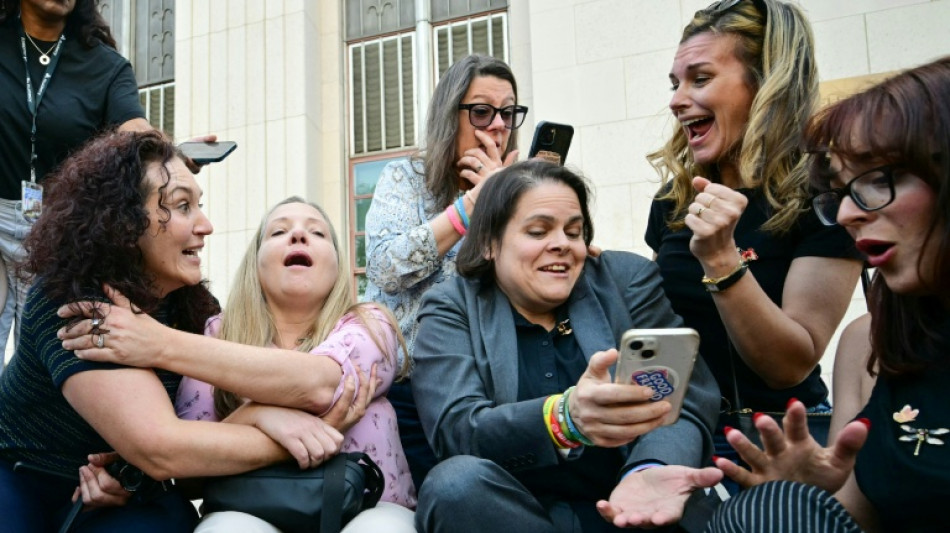
Grieving families hail court victory against Instagram, YouTube / Photo: Frederic J. Brown - AFP

Hearing the news that Instagram and YouTube had been found liable Wednesday for contributing to a young American woman's depression, Lori Schott jumped for joy and wept, as if it were her own daughter who had just won her case.
"We have ripped the door of this courthouse open in memory of our kids, and we're shining a light," the Colorado farmer told AFP, having traveled more than 1,800 kilometers (1,112 miles) to attend the verdict in Los Angeles.
It is "validation that what we saw, our children being harmed, was true. It's going to make the world safer."
This landmark trial involved Kaley G.M., a 20-year-old Californian who had been a compulsive user of various social media platforms since childhood and accused them of exacerbating her mental health issues and suicidal thoughts.
TikTok and Snapchat had reached a financial settlement to avoid going to court, but Google, the owner of YouTube, and Meta, the parent company of Instagram and Facebook, had opted for a legal battle.
The ruling on Monday ordering them to pay $3 million in damages is not just a victory for the young woman.
It also sets a precedent for thousands of American families who accuse the social media industry of knowingly designing its platforms to make children addicted, through features such as "likes," notifications, infinite scrolling, and autoplay videos.
- 'Predator' defense -
The platforms "had no defense" in this case, said Schott, outraged by the way Meta's lawyers attributed Kaley G.M.'s depression to her chaotic childhood -- surrounded by a neglectful father, a hot-tempered mother, and a sister who attempted suicide.
"Their defense is to attack Kaley and her family. And what does a predator do? A predator attacks the victim," she said.
Angry, the 60-year-old cannot come to terms with the loss of her daughter Annalee, a little blonde girl in a cowboy hat whose smile lights up the pin attached to the lapel of her jacket.
After her suicide at age 18, her mother discovered a note explaining that she thought she was ugly and realized that she constantly compared herself to other women on social media who regularly used filters to alter their appearance.
"It was all built into the design of these platforms to keep little girls engaged," she said, still shocked by the internal documents revealed during the trial.
These confidential records notably showed how their architecture reduced users to a series of statistics, such as "customer lifetime value," representing the total expected profit for a person over their entire time on the platform.
"Their internal operation said kids are worth $270 lifetime value," she whispered, her throat tightening. "My daughter is worth a hell of a lot more than $270."
- 'Shaping public opinion' -
During the trial, lawyers for YouTube and Instagram sought to convince the court that these platforms no longer aim to maximize the amount of time their users spend online, unlike in their early days.
Mark Zuckerberg, the CEO of Meta, also expressed regret on the stand that Instagram waited until 2022 to verify the ages of its users.
Outside the courtroom, his company is ramping up advertising to promote new Instagram accounts for teens, which are private by default and block messages from people not followed by users under 16.
The Silicon Valley giant is also promoting new features to alert parents if their teen repeatedly searches for content related to suicide or self-harm on Instagram.
But for Julianna Arnold, whose daughter Coco died at age 17 after receiving fentanyl from a stranger she met on Instagram, these efforts ring hollow.
"People need to wake up and start seeing through their PR. They're not doing nearly enough for kids' safety," said the Californian, co-founder of the victims' advocacy group Parents Rise.
For her, the increase in lawsuits against these platforms is essential, as the US Congress is currently considering a bill that would, for the first time, impose a "duty of care" on social media companies.
"This decision is not going to change everything, but it helps us to sway public opinion," she insisted. "That's the only way to get the ear of legislators in Washington."
A.Roth--MP