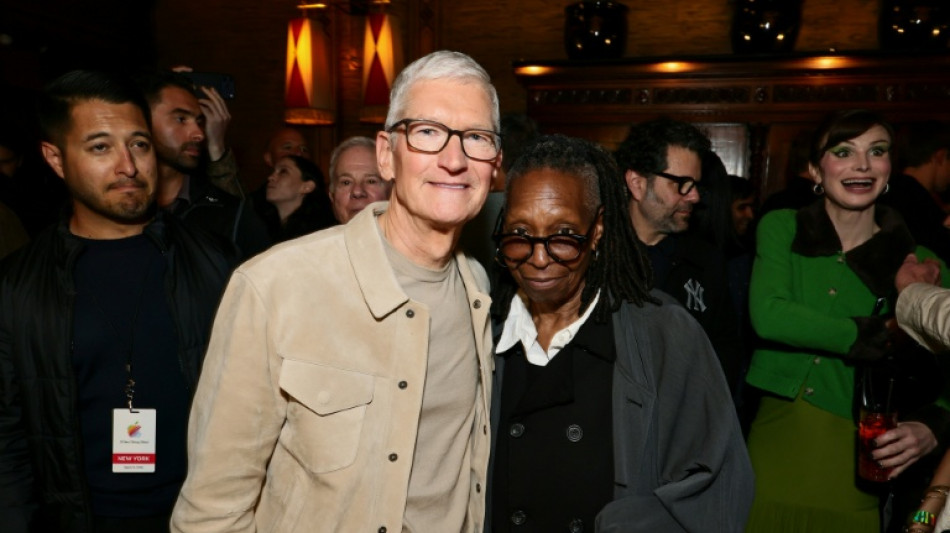
Apple's Tim Cook to step down as CEO after 15-year run / Photo: Theo Wargo - GETTY IMAGES NORTH AMERICA/AFP/File

Apple's Tim Cook will step down as the California tech giant's chief executive this year, handing the top job to a company veteran as it navigates a technology landscape being upended by AI.
The 65-year-old Cook, who ran Apple for 15 years after taking the reins from its visionary co-founder Steve Jobs, will be succeeded by John Ternus, a senior vice president of hardware engineering.
The announcement on Monday answered long-simmering questions about a successor for Cook, who said he will step down in September to become executive board chairman.
"It has been the greatest privilege of my life to be the CEO of Apple and to have been trusted to lead such an extraordinary company," Cook said in a statement.
He joined Apple in 1998, rising through the ranks and helping drive its success as chief operating officer coordinating the iPhone maker's complex supply chain.
He became chief executive in 2011 after Jobs left because of health issues.
Cook is credited with expanding Apple's product line and ramping up the company's value to around $4 trillion based on current share prices.
He was the mastermind of the strategy that made China the primary manufacturing base for Apple devices, with the vast majority of iPhones assembled by Foxconn and other contract suppliers in Chinese factories.
"Tim's unprecedented and outstanding leadership has transformed Apple into the world's best company," outgoing board chairman Arthur Levinson said in the statement.
"His integrity and values are infused into everything Apple does."
Ternus joined Apple's product design team in 2001 and became a senior vice president of hardware engineering over the course of the following two decades.
He is credited with playing roles in an array of products including iPhones, iPads, the Apple Watch and Mac computers.
"Having spent almost my entire career at Apple, I have been lucky to have worked under Steve Jobs and to have had Tim Cook as my mentor," Ternus said in the statement.
- Apple at 50 -
Apple marks its 50th anniversary this year as artificial intelligence challenges the Silicon Valley legend to prove it can deliver yet another culture-changing innovation.
"Ternus is not an unexpected choice, and he has a pedigree in hardware engineering, which will be critical for Apple's future foray into AI," said Kathleen Brooks, research director at the trading platform XTB.
"There is also anticipation of new Apple products to boost their offering, and there is some expectation that Ternus could move fast to put his own stamp on the company," she wrote in a research note.
Jobs, a driven marketing genius, and Steve Wozniak, who invented the Apple computer, revolutionized how people use technology in the internet age.
The two men, both college dropouts, changed the way people use computers, listen to music and communicate on the go, giving rise to lifestyles revolving around smartphone apps.
Apple's hit products command a cult-like following, long after the company's humble beginnings on April 1, 1976 in Jobs's Cupertino, California garage.
"Apple is making a major transition on its AI strategy and longtime CEO and legendary Cook leaving now is a surprise," Wedbush analyst Dan Ives said in a note to investors.
"There will be a lot of pressure on Ternus to produce success out of the gates especially on the AI front."
A concern haunting investors is that Apple appears to be easing into AI while rivals Google, Microsoft and OpenAI race ahead.
A promised upgrade to its Siri digital assistant was delayed, in what analysts called a rare stumble for the company.
Rather than relying on its own engineers to overhaul Siri, Apple has turned to Google for AI capability.
While Cook has guided Apple into new categories like watches and AirPods, he is not known for the kind of "big thing" that Jobs delivered.
Under Cook, Apple spent billions of dollars on a self-driving electric vehicle project it wound up scrapping in 2024.
An Apple Maps service launched in 2012 was so rife with error that Cook published an apology letter.
And, while a technical marvel, the Apple Vision Pro "spacial computing" headgear, with a price tag of $3,500, has found little traction in the market.
O.Wagner--MP