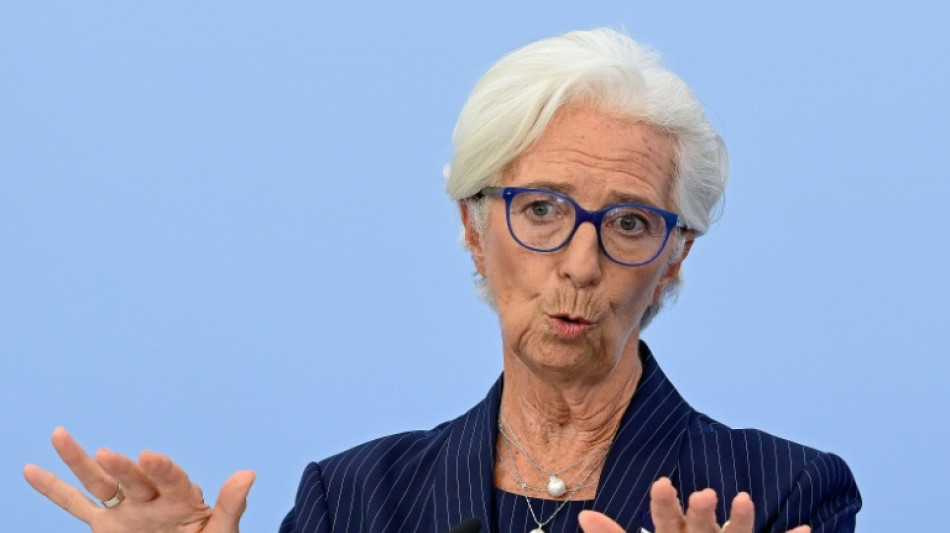
ECB lifts borrowing costs amid energy shock, opens door for more hikes / Photo: John MACDOUGALL - AFP
 17°C
17°C

The European Central Bank raised interest rates Thursday for the second time this year as renewed Middle East fighting fans fears of higher inflation, and opened the door for further hikes.
As widely anticipated, the central bank for the 21 eurozone nations lifted its benchmark rate a quarter percentage point to 2.5 percent, its highest level since March last year.
It was the ECB's second increase this year after policymakers lifted borrowing costs in June for the first time since 2023 in response to the energy shock triggered by the US war on Iran.
With renewed energy price rises set to push eurozone inflation even higher, President Christine Lagarde told a press conference that the unanimous decision by the ECB's governing council had been a "no-brainer".
"The conflict in the Middle East continues to generate inflation pressures, and inflation is set to remain well above target for an extended period," she said in Berlin, where rate-setters were meeting on one of their trips away from the ECB's Frankfurt headquarters.
Markets are pencilling in further hikes but Lagarde, as usual, declined to give clear guidance, saying the outlook was too unclear to plot a path ahead.
But the ECB hiked its growth forecasts for this year to 0.9 percent and for next year to 1.4 percent, underlining that the eurozone economy has withstood the Middle East war energy shock better than feared.
Lagarde said the near-term economic outlook had "improved", adding: "We have been surprised by the resilience of our economy."
The central bank also raised its inflation projections for 2027 and 2028, while maintaining this year's at three percent.
- 'Hawkish tilt' -
Analysts said Lagarde had struck a "hawkish" tone -- tilting in favour of further hikes -- opening the door for potential further tightening.
"The communications from the ECB can be read as at least having a hawkish tilt," said Roman Ziruk, FX Strategist at Ebury.
Lagarde "signalled that inflation is proving more persistent than expected (and) talked up the resilience of the eurozone economy," Ziruk said.
Fears of higher inflation are being fanned by rising global energy prices.
The Brent international oil benchmark has climbed back above $100 a barrel this week, while natural gas prices, a key energy cost for Europe, reached their highest level in more than three years.
The surge is being driven by an escalation in the US-Iran conflict as well as a flare-up in fighting between Saudi Arabia and Yemeni rebels, dimming prospects of Gulf energy shipments returning to normal.
But for households in the euro area, another rate hike means pricier mortgages, consumer credit and other loans.
The central bank has faced criticism in some quarters for trying to tackle an energy supply shock with tighter monetary policy.
Rate hikes aim to slow inflation by dampening demand from consumers and businesses, but critics say they can do little to tackle the root cause of the current burst in price rises -- a shortage of energy.
So far there has been little sign of eurozone inflation seeping more broadly through to the economy via higher costs for food, goods or services.
Some economists say the ECB is worried about a repeat of 2022, when the central bank was criticised for raising rates too slowly in response to the inflation surge following Russia's invasion of Ukraine.
Lagarde also faced questions about her own future after recent media speculation that she could step down as ECB president before the end of her term in October, 2027 and take over the presidency of the World Economic Forum.
But she refused to be drawn on the topic, telling journalists: "When there is something to report about me personally, you'll be the first one to know... and there is nothing to report."
L.Gschwend--MP