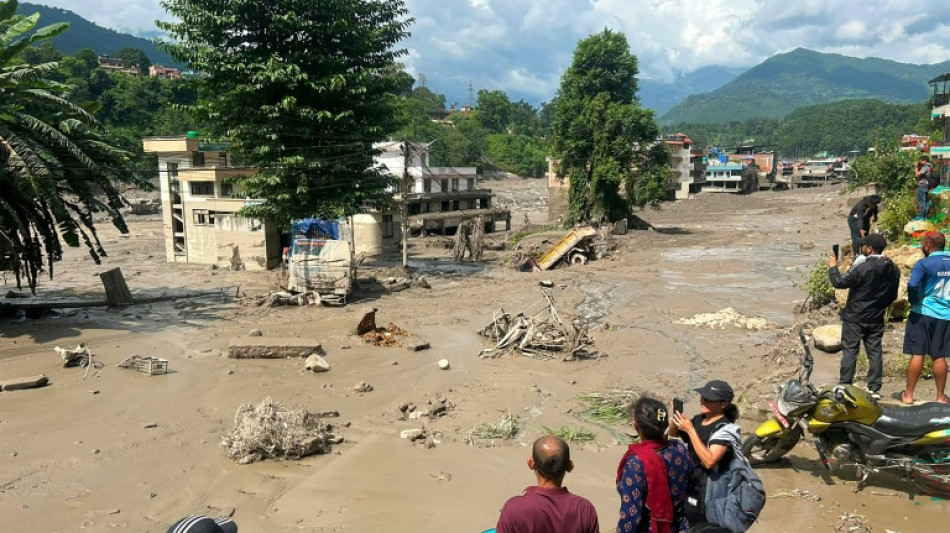
Researchers eye AI revolution in natural disaster forecasts / Photo: Prakash MATHEMA - AFP
 12°C
12°C

A revolution in forecasting natural disasters is underway, say researchers in Switzerland who are training AI models on vast troves of NASA climate data to produce potentially-lifesaving data at lightning speed.
They are feeding the NASA file stash into one of the world's most powerful supercomputers so artificial intelligence can speed up and expand vital weather and climate forecasting, and spot patterns scientists could not have seen.
AI models are increasingly used in weather and climate forecasting and for early detection of natural hazards.
As well as speed, they carry the promise of spotting previously imperceptible patterns in satellite and other data, potentially making it possible to flag in advance disasters like Nepal's devastating flood, which last month left thousands dead or missing.
But training such AI models requires vast amounts of high-quality climate and Earth observation data, and significant computing power.
Researchers at Switzerland's Federal Institute of Technology Zurich (ETH) say they now have both, after copying around 100 petabytes of publicly available NASA data onto servers adjacent to one of the world's most powerful supercomputers, known as Alps.
"This is a huge scientific opportunity," said Thomas Schulthess, an ETH computational physics professor and head of the Swiss National Supercomputing Centre (CSCS) in the southern city of Lugano.
Standing in front of rows of what look like giant filing cabinets that contain Alps, he told AFP he was excited to have all of NASA's climate data plugged directly into the machine.
"It's really enabling scientists to do things we would not even have thought of before," he said.
- Data is 'everything' -
It took approximately a year to copy the roughly six billion NASA files onto servers connected to the supercomputer, said Reto Knutti, a climate physics professor who heads ETH's Center for Climate Systems Modeling (C2SM).
That is equivalent to around 20 million feature-length films in terms of data volume, or around a million times the storage on a typical computer, he told AFP.
Now the researchers are using the mass of information to develop AI models that can speed up and expand vital weather and climate forecasting.
"Data is essentially everything," Knutti said.
"The next step will be making sense of the data".
That is where the proximity to the massive computing power of Alps comes in, Schulthess said, nodding to the clusters of servers humming loudly just metres (feet) from the supercomputer.
"It matters whether you can move the data within a few seconds or whether you have to wait days for the data to come," he said
New AI-generated statistical models are far faster than the traditional process of using mathematically equations to simulate the complex processes taking place in the oceans and atmosphere.
There is "a revolution in weather forecasting", Knutti said, describing the statistical models as "really, really powerful" and "incredibly fast".
- 'Save lives' -
Instead of the hours traditionally needed to produce a forecast, a statistical model based on pattern recognition "can run a global weather forecast for multiple days -- the whole globe -- in a minute or so", he pointed out.
And while expensive to train, the models are "cheap to run", he said, meaning "you can do more iterations, maybe every few minutes, to see if some specific weather pattern exists".
"That allows us to do early warning systems to save lives."
Not all disasters are foreseeable but those that relate to geology, like landslides and glacier collapses, can often be detected early in the data, if there is capacity to spot the pattern.
Kutti pointed to the case of the Swiss village of Blatten, which was wiped out by a dramatic glacier collapse in May last year, "that was visible in satellite data more than a year before it actually happened".
Thanks to close monitoring, Swiss authorities evacuated the village a week before the collapse, avoiding mass casualties.
Closer monitoring could also possibly have sounded the alarm before the devastating August 26 glacial collapse on the Nepal-China border.
Nature reported last week satellite image analysis showed some warning signs before the disaster, which, had they been spotted, could have flagged the area "as a hotspot warranting closer attention and monitoring".
Knutti agreed that this was a good example of how satellite data could potentially be used for "systematic observing systems for disaster prevention that could save hundreds or thousands of lives".
A.Weber--MP