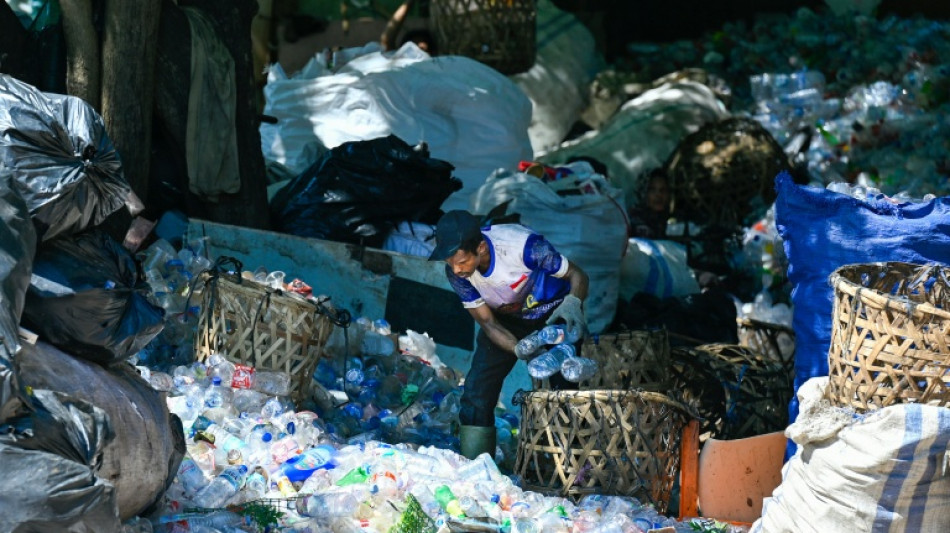
Plastic treaty talks chair sees deal possible in March / Photo: CHAIDEER MAHYUDDIN - AFP
 16°C
16°C

Countries negotiating a world-first treaty to limit plastic pollution are less divided than before and a deal could be agreed in March, the diplomat chairing the talks told AFP on Thursday.
Chilean ambassador Julio Cordano took over the role earlier this year after his predecessor resigned, and with the talks having overrun their initial schedule by more than a year.
But speaking in Bangkok after informal closed-door talks with heads of delegations, Cordano said he was hopeful a deal could be clinched at the next official round of negotiations.
"My plan and my expectation is that we will be able to adopt the treaty in INC 5.4 (March meeting), if we follow the correct steps, if we make consistent progress, and if we complete the roadmap that I presented," he said.
Work on a treaty to address plastic pollution began in 2022 with a two-year timeline.
But crunch talks in South Korea in 2024 fell apart, and a renewed effort in Geneva the following year made no progress either.
A majority of nations have called for ambitious, legally binding measures to curb production of plastic, which is expected to triple by 2060.
But a smaller bloc of mostly oil-producing states -- including Saudi Arabia, Kuwait and Russia -- have pushed back against such restrictions, seeking to focus more narrowly on waste management.
Ahead of the Bangkok talks, Cordano released an "aid to negotiations" -- a non-binding outline of a possible treaty, with brackets around the most contentious sections.
These are mostly the same issues that sank previous rounds, including a cap on plastic production, mention of human health, and designating problematic plastic products or chemicals of concern.
But Cordano insisted countries were not as far apart as they might seem.
"I think you would be surprised to hear members on these topics. I think they are much more closer than simply binary positions that are irreconcilable," he said.
- Pragmatism -
Sources told AFP some countries are increasingly supportive of a document that would offer options, with more ambitious countries choosing to limit production or certain products, while others do not.
Cordano said the idea of "different pathways or different departure points" was "embedded in our mandate."
He also called for pragmatism and a focus on the end goal of a treaty.
"There's more than one way to achieve that, and I think members are realising that."
There are still serious disputes to resolve however, including mechanisms for adopting a treaty and amending it in the future.
Some countries want all decisions to be made by consensus, which opponents say allows a small minority to block progress.
Cordano said his goal remained a "treaty that will be accepted by everyone," but he acknowledged concerns about future application of a deal if consensus is the rule.
It is "about how can we collectively understand and come up with a system that would allow this treaty in the future to be effective, not to be stopped, not to be frozen because there is no consensus," he said.
The diplomat expects to release a new "aid to negotiations next month, before a last round of informal talks in January.
"Everybody sees that this is a problem that requires a solution," he said.
"I think people are seeing eye-to-eye... I think this is a reason to be optimistic."
I.Frank--MP