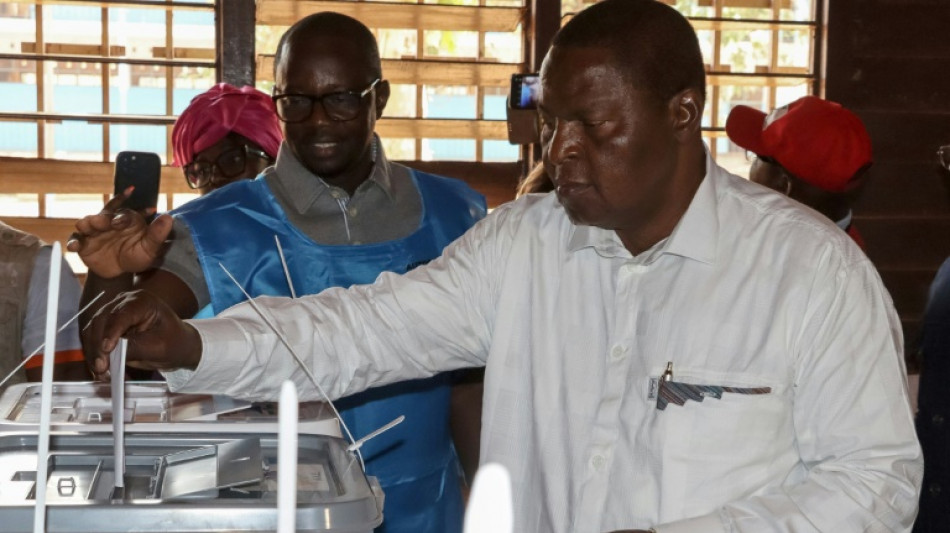
Central African Republic president tipped to win third term / Photo: Annela NIAMOLO - AFP

The Central African Republic's incumbent president, Faustin-Archange Touadera, was widely expected to win a third term in an election Sunday in which he touted his efforts steadying a nation long plagued by conflict.
Part of the opposition called for a boycott of the poll, in which 2.3 million people were eligible to vote, condemning it as a sham and lacking political dialogue.
Provisional results from the presidential election were expected on January 5.
Touadera went into the election in pole position in a seven-strong field, after a new constitution was adopted in 2023 allowing him to seek a third term.
Voters cast ballots not only for their choice of president, but also in parliamentary, municipal and regional elections that were held at the same time.
Voting ended at 1700 GMT. Nazaire Patchbale, in charge of the polling station in the city hall in the capital Bangui, said "people were able to vote in calm, without incident".
In another polling station, a 37-year-old who gave only his first name, Beranger, told AFP he did not vote, explaining that he saw some people not on electoral rolls being allowed to cast ballots, and others on the rolls but without electoral cards barred from doing so.
Touadera, 68, turned up to vote escorted by members of the presidential guard -- and by contractors with Russia's Wagner paramilitary group, which has established itself as one of the government's main security partners.
Streets in Bangui were quiet through the day, with armoured vehicles of the UN peacekeeping mission MINUSCA deployed at road junctions and heavy security outside voting stations.
Since Touadera was first elected in 2016, in the middle of a civil war, the Central African Republic has seen unrest ease, although feuds persist between armed groups and the government in some regions.
The main challenger to Touadera for the presidency Anicet-Georges Dologuele voted in Bangui earlier Sunday. He came in second place in the last two elections.
Afterwards, he said: "I will respect the choice of the ballot box, since I’m going to win."
- Rivals sidelined -
More than 1,700 national and international observers have been accredited for Sunday's polls, the electoral body said.
The ballot, along with a Guinea presidential vote on Sunday, capped a packed year of elections across Africa.
During campaigning, Touadera held rallies in Bangui stadium, but his Dologuele and another top rival, former prime minister Henri-Marie Dondra, were prevented from flying to the provinces to hold rallies and had to do neighbourhood walkabouts and events in schools or party offices.
Dologuele and Dondra also faced the prospect of being barred from standing over allegations they held another country's citizenship.
Dologuele was stripped of his Central African passport in October even after giving up his French citizenship. He has filed a complaint to the UN's human rights office.
Touadera, in the lead-up to Sunday's election, boasted of improvements in security, paved roads, public lighting on major avenues and renovated rainwater drainage canals in the capital.
But life for many in the country -- 71 percent of whom live below the poverty line -- remains precarious, with a lack of basic services, an absence of passable roads, widespread unemployment, poor training and a steadily rising cost of living.
Nearly 90 percent of the country is now under government authority, compared to 80 percent being held by armed groups four years ago, analysts have told AFP.
E.Schmitt--MP