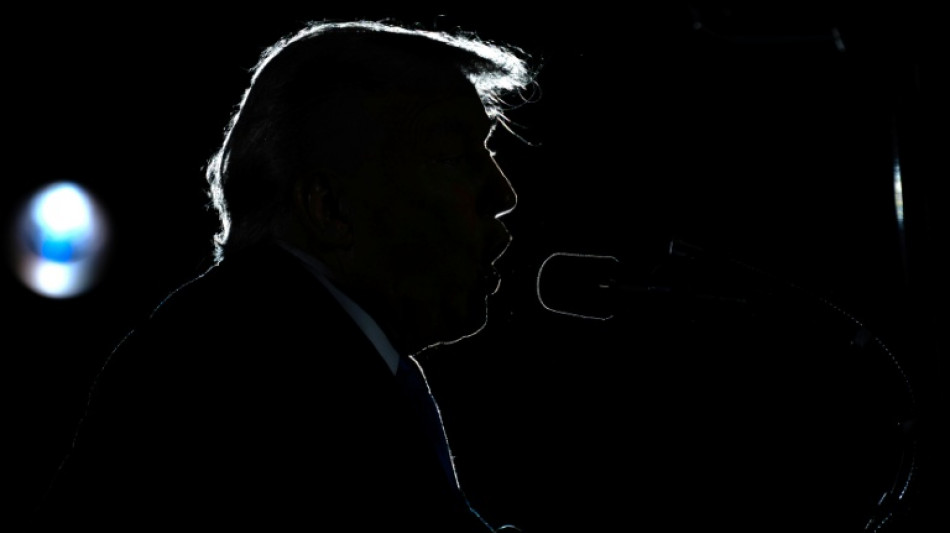
White House X account alters protester photo to add tears / Photo: SAUL LOEB - AFP
The White House's X account on Thursday posted a doctored photo of a protester arrested in Minnesota, showing her face contorted with tears without disclosing that the photorealistic image had been altered.
The edited photo of Nekima Levy Armstrong -- among three people arrested for allegedly disturbing a church service while protesting an immigration crackdown -- illustrates how President Donald Trump's administration is increasingly using deepfakes or AI imagery to make political arguments.
On Thursday morning, Secretary of Homeland Security Kristi Noem posted an image on X showing Armstrong's arrest, her face calm and expressionless.
About 30 minutes later, the White House posted the same image on the platform, but altered to show Armstrong sobbing, her mouth open, forehead wrinkled, and tears streaming down her face.
A caption superimposed on the image read "ARRESTED," labeling Armstrong a "far-left agitator."
The White House post offered no disclaimer that the image had been edited, and it was not immediately clear whether the alteration was done using an AI tool or other photo editing software.
When reached for comment, the White House redirected AFP to a post on X by White House Deputy Communications Director Kaelan Dorr, who tacitly acknowledged that the image had been modified.
"YET AGAIN to the people who feel the need to reflexively defend perpetrators of heinous crimes in our country I share with you this message," Dorr wrote on X, resharing the White House post featuring Armstrong's altered photo.
"Enforcement of the law will continue. The memes will continue. Thank you for your attention to this matter."
Underneath the White House post, several users questioned why the image had been altered to make Armstrong appear to be crying.
"We should be disturbed by any party using AI to manipulate photographs and presenting them as fact, which appears to be the case here," one user wrote.
"This point of view should have bipartisan agreement."
- 'Lack of decorum' -
In the age of deepfakes and AI, such edited images are now "commonplace in partisan politics," said Walter Scheirer of the University of Notre Dame.
"They are frequently used to humiliate opposition figures or make exaggerated political statements that resonate with a political base," Scheirer told AFP.
"One could consider this the contemporary version of newspaper political cartoons, but there is a notable lack of decorum when it comes through official government communication channels."
During the first year of his second White House term, Trump ramped up his use of hyper-realistic but fabricated visuals on Truth Social and other platforms, often glorifying himself while lampooning his critics.
Trump or the White House have similarly shared AI-made images depicting the president dressed as the pope, roaring alongside a lion, and conducting an orchestra at the Kennedy Center -- Washington's premier arts complex -- where he installed himself as chair of the board.
Underscoring the strategy's potential appeal to younger voters, similar AI-driven messaging has also been adopted by other arms of the Trump administration as well as by some of the president's political rivals.
A.Meyer--MP