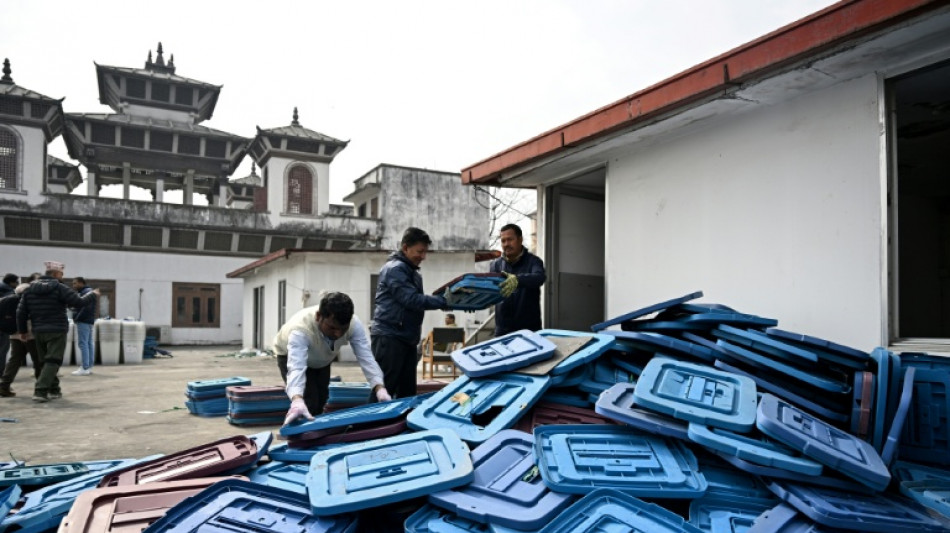
Nepali migrant workers influence polls, but can't vote / Photo: Prakash MATHEMA - AFP/File

Overseas Nepali workers bankroll their families and buttress the economy, making them a key constituency in elections next week -- but they cannot vote themselves.
The Himalayan republic votes on March 5 in the first parliamentary elections since deadly youth-led protests toppled the government in September, fuelled by anger at a woeful economy and lack of opportunities.
Unable to find jobs at home, some 2.5 million Nepalis -- 7.5 percent of the population -- work abroad to support their families, according to government figures.
Political parties court migrants for the powerful influence they wield over voters back home.
"As they are the main breadwinner of their families, they have a lot of influence," said Ganesh Gurung, chief of Nepal's Policy Research Institute.
"Migrant workers are very active on social media," he added, noting that online commentary has long shown "a lot of frustration" with successive governments.
Nearly 90 percent of overseas workers have a "strong interest" in voting, according to a survey published in a report by Nepali migrant rights groups after last year's uprising.
"Indirect participation -- such as recommending family voting choices or supporting campaigns online -- is common," read the report by migrant rights groups Shramik Sanjal and the Law and Policy Forum for Social Justice (LAPSOJ).
The money they send back, from the Gulf and Saudi Arabia, or India and Malaysia, is equivalent to more than a third of GDP, according to the World Bank.
"I have never exercised my voting rights because I was abroad when I turned 18," Pradip Bagale, 43, a hotel worker in Qatar with two sons in Nepal, told AFP.
"After the Gen Z movement, I thought the government would finally allow us to vote... but it did nothing."
- Stalled efforts -
But legal efforts to challenge a 2017 election have made little progress. There is no system for them to cast ballots at embassies, by mail or electronically.
The interim government -- which took over after the September uprising -- said it backed overseas voting, but reforms did not come in time.
"The procedure couldn't be changed without a legal basis and proper training," said Prakash Nyaupanem, an Election Commission spokesman, adding that polls were "organised in a very short time".
In 2018, the Supreme Court ordered the government to "take measures", but there has been no "significant development" since then, said human rights lawyer Barun Ghimire.
Lawmakers drafted a new act in 2023, but budget constraints and security concerns about electronic voting meant "it never materialised", a former member of the Electoral Commission said on condition of anonymity.
In 2022 elections, the Rastriya Swatantra Party (RSP) made it a key issue -- and shocked traditional parties by becoming the fourth-largest force in parliament.
The same year, Balendra Shah, 35, drew on the support of migrants to be elected Kathmandu's mayor.
Shah is the RSP's prime ministerial candidate next week.
"He was elected mayor because of the pressure from Nepali nationals living abroad," said Nilambar Badal, from the National Network for Safe Migration. "They influenced people in Kathmandu to vote for him."
- 'Inevitable' change -
Shah told AFP that migrants "should get voting rights", saying he would tackle the issue "if we reach government".
Other countries allow citizens based overseas to vote.
"If both the government and the Election Commission had the willingness, they could have extended the election timeline and included Nepalis living abroad," said Neil Kantha Uprety, a former chief election commissioner.
Lawyer Ghimire said he believed such a change was "inevitable", adding that the mere fact the issue was being debated made him "optimistic".
Once expatriates were included, their voice would aid democracy, he said.
"Imagine a million people voting for a single political party," he said. "That changes the entire political landscape. They could hold those elected accountable."
T.Gruber--MP