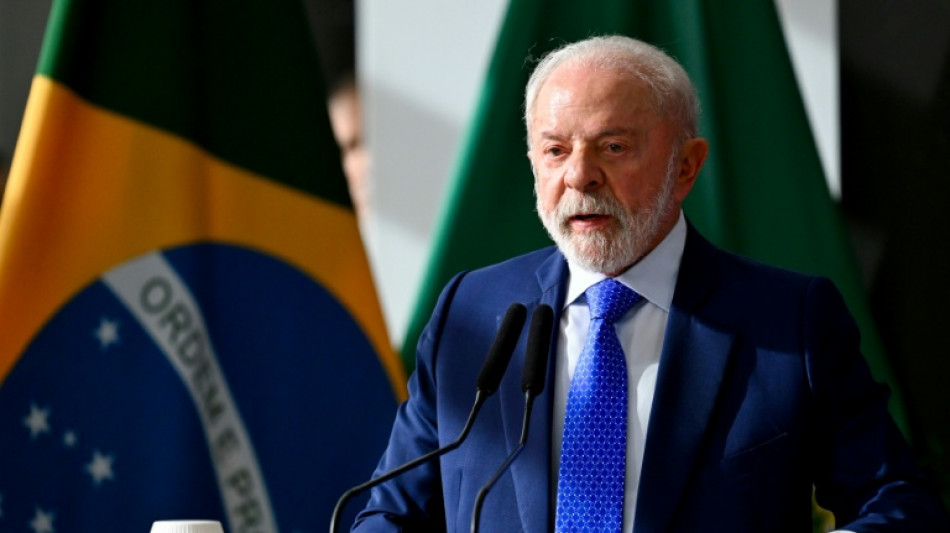
Brazil's economy slows as high interest rates curb growth / Photo: Evaristo SA - AFP

Brazil's economy grew 2.3 percent in 2025, cooling from the previous year as its interest rates remained among the highest in the world, official data showed Tuesday.
The slowdown -- in line with market expectations -- comes seven months before Latin America's largest economy holds presidential elections in October.
Economist Andre Perfeito attributed it to persistently high interest rates, which are impacting investment, and low household consumption.
In 2024, Gross Domestic Product (GDP) grew 3.4 percent.
In the fourth quarter of last year, the economy grew 0.1 percent compared with the previous quarter, the Brazilian Institute of Geography and Statistics (IBGE) said.
"GDP remained stable compared to the third quarter, even with the decline in investment, due to stable household consumption and growth in government spending," Rebeca Palis of the IBGE said in a statement.
She added that economic growth had been driven by activities "less affected by the tight monetary policy."
The GDP figure "isn't bad," economist Perfeito told AFP, but given unemployment is already at its lowest level since 2012, it is not "cause for celebration."
He said one of the biggest challenges was families spending less as debt mounts due to high interest rates.
Brazil's central bank kept its benchmark Selic rate at 15 percent in January, for the fifth time in a row, in a bid to curb inflation which stood at 4.44 percent the same month.
However, the bank signaled a possible cut in March, depending on the "uncertain external context," referring to global trade tensions and US economic policy.
President Luiz Inacio Lula da Silva, who is seeking a fourth term in October at the age of 80, has criticized high interest rates, which he says are holding back the economy.
In 2025, economic growth was led by the agricultural sector with record harvests of corn and soybeans -- of which Brazil is the world's largest exporter.
Oil and gas extraction also made a strong contribution.
Industry grew 1.4 percent and services 1.8 percent.
Brazil's economy was hit by US tariffs of up to 50 percent, which came into effect in August.
However, Washington has since exempted key export items such as beef and coffee.
S.Kraus--MP