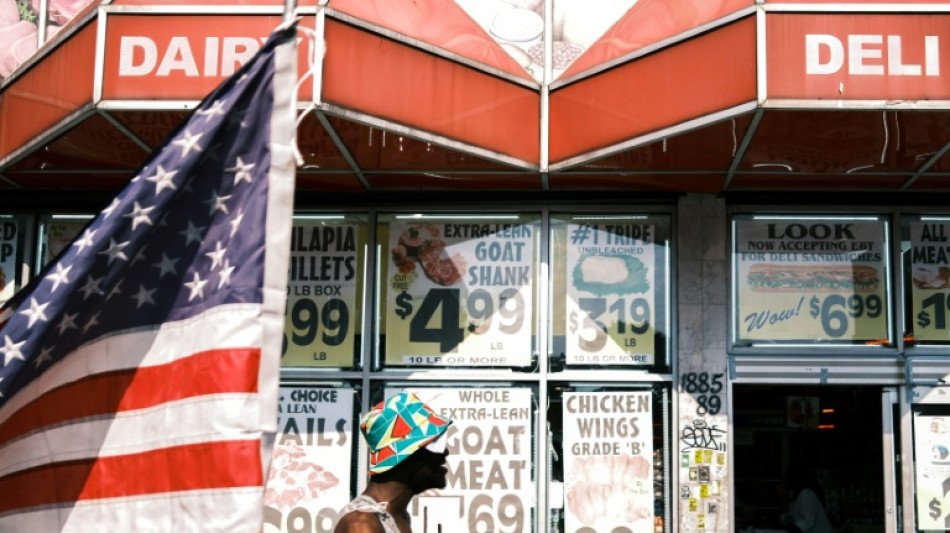
Scary times for Haitians in US living in shadows of ICE / Photo: CHARLY TRIBALLEAU - AFP

Life has not always been easy for Maryse Balthazar since she relocated to the United States from Haiti, but she felt peace of mind before Donald Trump returned to office.
"You didn't have anxiety, like, 'When are they going to grab me?'" the certified nursing assistant told AFP in a phone interview from Boynton Beach, Florida. "It's scary."
Balthazar, who stayed in the United States after a devastating 2010 earthquake hit Haiti, is one of some 350,000 Haitian nationals granted Temporary Protective Status but now in the crosshairs of the Trump administration's crusade against immigrants without papers.
Trump and recently-ousted homeland security secretary Kristi Noem have repeatedly sought to terminate TPS for Haiti, a move that would shift the population's status from legal to illegal immigrants.
These efforts to send Haitians back home come even as the US State Department keeps a red alert on the country over robbery, sexual assault, gangs and other ills, saying, "Do not travel to Haiti for any reason."
The Trump administration had designated the program to end on February 3, but the order was suspended by US District Judge Ana Reyes on February 2.
Reyes' decision was hailed by Colin O'Leary, who runs a 120-bed Ascentria nursing home in Boston that, like other US senior care facilities, includes a heavy number of Haitian workers.
"We've now had three different times where we thought we were losing a significant portion of our staff," said O'Leary.
While Ascentria attorneys have cleared TPS holders to keep working, Balthazar said her son lost his receptionist job.
Stories of job loss abound within the US Haitian diaspora as some employers become skittish over the uncertainty surrounding TPS.
Doris Etheart, who runs a Caribbean foods store in New York, said a couple of cousins who arrived in 2024 were dismissed from their jobs as security guards.
The relatives have been keeping a low profile, said Etheart, who was born in the United States from parents who emigrated from Haiti in the 1990s.
Foot traffic near Etheart's store in Brooklyn's "Little Haiti" is much diminished.
"All of them are just in fear," Etheart said. "They're in hiding because of this."
- Congressional push -
The current judicial battle revives a legal fight after the first Trump administration's efforts to end TPS remained stuck in the courts. Former presidents Joe Biden and Barack Obama extended TPS for Haiti.
Reyes' ruling characterized Haiti as "a country in chaos and crisis," pointing to supporting 2025 statements from Secretary of State Marco Rubio and noting that plaintiffs in the case would be gang targets or deprived of needed medical supplies if deported to Haiti.
Withdrawing TPS for Haiti lacked sufficient review, likely reflecting "hostility to nonwhite immigrants," Reyes wrote, citing a Noem social media post dismissing migrants as "killers, leeches and entitlement junkies."
The ruling also highlighted the role of Haitian labor in health care and other sectors, noting the population generates $5.2 billion in taxes annually.
While Reyes' decision means that TPS holders can't be legally deported right now, many in the community remain on guard.
Eno Mondesir, a Massachusetts public health official who is also a pastor, has been advising Haitian nationals with kids to line up friends in case they are detained.
"With this present administration, they can apprehend anyone just as they won't back down from killing American citizens," said Mondesir, a US citizen who emigrated from Haiti in the 1980s.
"I never expected to see in the US complete disregard for human rights and violation of the Constitution and the law of the land," Mondesir said.
The Trump administration on Wednesday filed a request with the Supreme Court asking it to halt Reyes' order.
There has also been a push in Congress led by Massachusetts Democrat Representative Ayanna Pressley with more than 170 supporters for legislation to require the administration to designate Haiti for TPS.
Advocates of the Haitian community have been encouraging business groups with large immigrant workforces to lobby behind the scenes if they won't publicly criticize the Trump administration.
"The politics has made it hard for businesses to advocate for their own interests because they're worried about retaliation," said Brian Concannon, executive director of the Institute for Justice & Democracy in Haiti.
The drive in Congress offers another source of hope for home health care worker Balthazar as she nervously monitors the courts.
"We have a lot of people fighting for us," she said. "With a troop, you can win. Solo, it's hard."
T.Murphy--MP