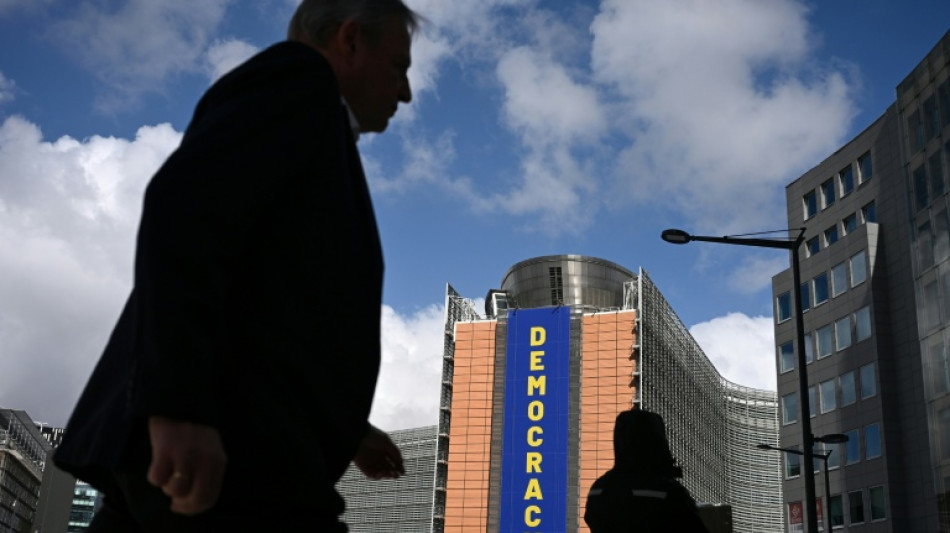
Taliban officials hold EU migration talks in Brussels / Photo: Nicolas TUCAT - AFP
 9°C
9°C

Taliban government officials held talks with the EU Tuesday in Brussels about returning failed asylum-seekers to Afghanistan, in a visit fiercely criticised by rights activists.
The European Commission invited a five-person delegation for discussions under a push to crack down on irregular migration and boost deportations -- although the EU does not formally recognise the Taliban administration.
A source informed about the trip confirmed the delegation had arrived in the Belgian capital, where they were granted a one-day visa for the talks -- the first by Taliban officials with EU representatives in Brussels.
A second informed source said talks with the EU side took place as planned, with a focus on resuming consular services for Afghans in Europe, on "confidence-building measures" and "a dignified return process."
The Taliban delegation was led by foreign ministry spokesman Abdul Qahar Balkhi, and included representatives of the Afghan interior ministry, the source said.
The visit has drawn strong pushback from rights campaigners who say it flies in the face of the European Union's values.
"The Taliban have erased women and girls from public life," said Nobel Peace Prize laureate Malala Yousafzai -- who was shot by Pakistan Taliban militants at the age of 15 -- adding she was "shaken and deeply disturbed" by the EU's invitation.
A commission spokesman said the "technical level" meeting had been arranged upon the request of 20 EU countries and would provide them the opportunity to "establish contacts" with Taliban authorities.
"The focus of these member states is to return persons who have committed serious crimes or who pose security threats," Markus Lammert told journalists, declining to provide further details on the closed-door talks.
The meeting followed a January visit by EU officials to Afghanistan to explore the feasibility of the possible organisation of returns.
EU countries are responsible for arranging repatriations, although the commission can play a coordinating role.
- 'Unconscionable' -
In its capacity as host country to the European institutions, Belgium confirmed Monday it had issued the Taliban delegation five one-day visas "after a security assessment" -- valid just for Belgium and not the broader free-movement Schengen area.
EU nations and the commission have denied that hosting Taliban officials is tantamount to recognising the government in Kabul, but critics say it reneges on the bloc's values.
"EU countries are undermining their credibility by condemning Taliban abuses and pursuing accountability on one hand, while cooperating with the Taliban to forcibly return Afghans on the other," said Fereshta Abbasi of Human Rights Watch.
European governments shut their embassies in Kabul when the Taliban authorities returned to power in 2021 and imposed their strict interpretation of Islamic law.
Women in Afghanistan must be almost entirely covered when they leave home and are banned from a host of public places, including parks and gyms, while girls' education stops at age 12.
This month, the European Union's migration chief Magnus Brunner defended the outreach, saying Brussels had no other option than to talk to the Taliban government about returning irregular migrants from Afghanistan.
European governments have sought a tougher stance on migration as public opinion has hardened, fuelling far-right electoral gains across the continent.
EU countries received about a million asylum applications filed by Afghans between 2013 and 2024, according to the bloc's data agency. About half as many were approved over the period.
Around 20 of the EU's 27 member states have expressed interest in returning some migrants without a right to stay to Afghanistan.
Some countries have pushed ahead, with Germany deporting more than 100 Afghans with criminal convictions since 2024, via charter flights facilitated by Qatar, and Austria following suit.
Rights groups have questioned the legality and ethics of returning migrants to a country that is in the midst of a severe humanitarian crisis, with millions facing hunger and economic hardship, according to the United Nations.
"The desperate scenes of people -- including EU staff -- fleeing Afghanistan are a recent memory," said Eve Geddie, Director of Amnesty International's European Institutions Office.
"It is unconscionable that the EU would now try and deport people to Afghanistan, which has only become more dangerous in the meantime."
A.Weber--MP