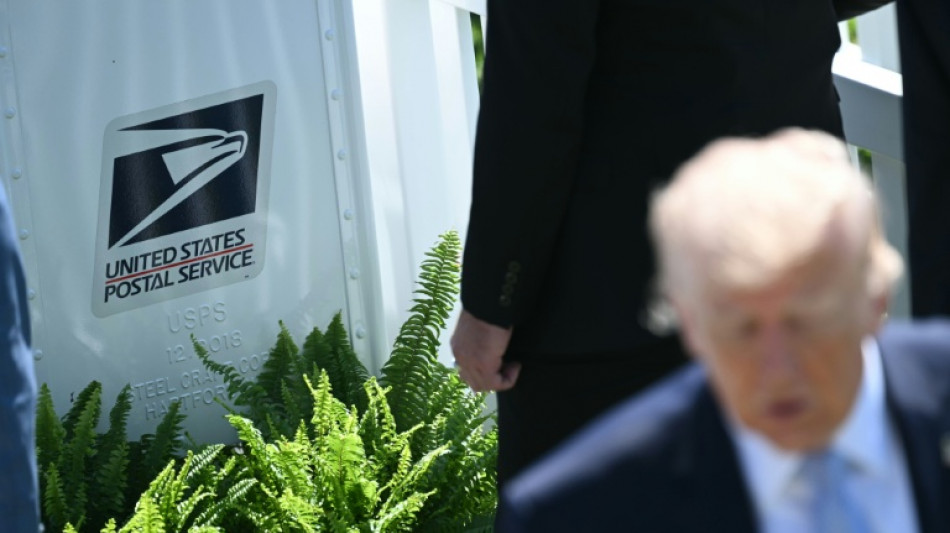
US midterms begin with chaos over mail-voting crackdown / Photo: SAUL LOEB - AFP/File
 28°C
28°C

America's midterm elections opened Friday in a fog of confusion over mail voting, with ballots already going out as President Donald Trump presses courts to let him impose sweeping new restrictions on how they are handled.
North Carolina became the first state authorized to begin sending out ballots, formally launching an election season that culminates on November 3 and will determine control of Congress for the final two years of Trump's term.
Yet voters and election officials still do not know what rules may govern millions of mail ballots, as Trump asks the Supreme Court to revive curbs blocked by a federal judge and as states scramble to prepare for changes that could come after voting has begun.
The dispute has been compounded by whistleblower allegations that a new Postal Service verification system was rushed, inadequately tested and could delay or even disqualify entire batches of ballots because of a single barcode problem.
A federal judge weighing whether to extend the temporary block on Trump's plan warned Thursday that hurried changes could cause widespread disruption.
"We're not playing an intellectual puzzle game," Judge Indira Talwani reportedly told a lawyer defending the restrictions, in remarks widely picked up by US media. "We're talking about people's right to vote."
Trump's March executive order would require states to provide the US Postal Service with lists of eligible mail voters through a new federal portal.
- Rules in limbo -
Ballot envelopes would also need individual barcodes and other design features, with USPS empowered to refuse mailings that fail to meet its requirements.
The administration says the rules are to protect election integrity, although it has produced no evidence of significant fraud through mail voting.
Trump has repeatedly denounced the practice as corrupt while using it himself -- including to vote in Florida's Republican primary just last month.
The uncertainty comes on top of a voting system that already differs dramatically from state to state.
Some automatically send ballots to registered voters, others require voters to request them, while identification requirements, return deadlines and rules for counting late-arriving ballots vary across the country.
Election officials now face the additional prospect of federal requirements changing while voting is already underway.
"The states set the time, place and manner of elections in this country, not the president," Marc Elias, the founder of voting rights platform Democracy Docket, said on his YouTube show.
"In fact, the Congress can override the states in many instances, but in no instance can the president. The president is given no power over federal elections."
North Carolina officials said Friday's mailings would proceed normally and that the state has no plans to use the federal portal at the center of the dispute.
But time is rapidly running out for any nationwide overhaul.
- 'Rushed, chaotic' -
Friday marks 60 days before Election Day -- the deadline Trump's order itself envisioned for states to submit voter information -- while another 18 states are expected to begin distributing ballots roughly 45 days before November 3.
That leaves little room for officials to redesign envelopes, update computer systems, train workers and upload voter data if the courts suddenly allow the restrictions to take effect.
Concerns intensified this week after an anonymous USPS whistleblower alleged that the ballot portal had been developed through a "rushed, chaotic, and fundamentally flawed" process.
The official warned that under a proposed "zero-percent failure" policy, one barcode that fails to scan or match could result in an entire batch containing thousands of ballots being rejected until it is checked again.
USPS told AFP no mandatory verification procedures were being performed and that election officials would initially use its portal only voluntarily.
The fight -- alongside disputes over partisan redistricting in around a dozen states -- come with high political stakes.
Republicans hold narrow congressional majorities, but Democrats are favored to capture the House as Trump's approval ratings remain weak and voters voice frustration over living costs and the continuing war with Iran.
A new Cornell University forecast gives Democrats an eight-in-10 chance of taking the chamber, projecting a roughly 226-209 majority.
O.Braun--MP