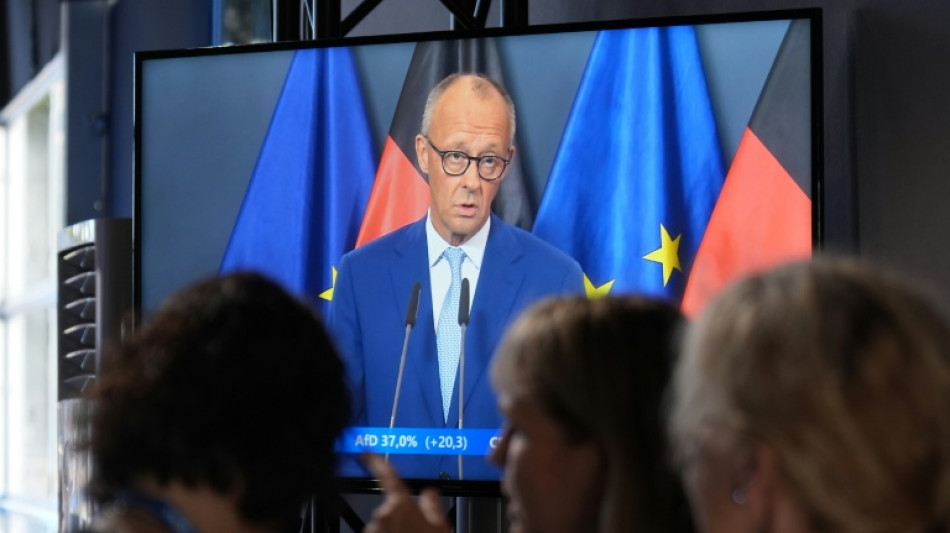
Germany's Merz vows to stay course despite new election defeats / Photo: Marcus Brandt - POOL/AFP
 16°C
16°C
Germany's embattled Chancellor Friedrich Merz vowed to stay the course on Sunday despite stinging election defeats in two states at the hands of the far-right AfD and the far-left Die Linke party.
"What needs to be done now requires backbone, steadfastness and patience," Merz said at a Berlin crisis meeting of his centre-right CDU. "I will demonstrate this as CDU party chairman and, above all, as chancellor of our country."
The AfD had a narrow lead of about 37 percent in the northeastern state of Mecklenburg-Western Pomerania against 35 percent for the centre-left SPD, according to exit polls by public broadcasters ARD and ZDF.
Merz's CDU crashed below five percent in the ex-communist eastern German state, meaning it got kicked out of parliament -- its worst result ever and an outcome Merz admitted was a "disaster".
In Berlin, the far-left Die Linke party with about 25 percent easily defeated the ruling CDU, which scored 19 per cent.
"In our city, love and justice have triumphed over hatred," said Die Linke's lead candidate Elif Eralp, the daughter of Turkish migrants, celebrating her party's triumph over the anti-immigration AfD.
Merz -- who had called the crisis meeting in anticipation of a poor result -- quickly stepped before the cameras and vowed to stay the course, following recent speculation he may soon be ousted by his party.
"The reforms have to come," 70-year-old Merz said. "I am taking on this responsibility because I want to move our country forward."
Merz acknowledged that "trust in our country's institutions is waning" and said it was being "actively undermined by radical parties on both the left and the right".
ING economist Carsten Brzeski said of Merz's rushed TV address: "Read the appearance for what it was, an attempt to choke off the speculation about his possible resignation that has been building in recent weeks."
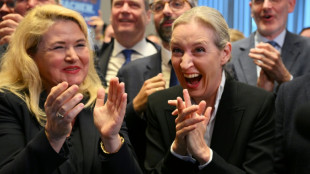
The AfD's jubilant national co-leader Alice Weidel said: "We are the strongest force and have reached the mainstream of the population."
- Poor approval ratings -
Merz -- with record low personal approval ratings after 16 months in office -- has been fighting off rumours he may be ousted by his centre-right CDU/CSU bloc.
With Sunday's elections looming, the chancellor has also cleared his calendar for this week, skipping a trip to the UN General Assembly to deal with potential aftershocks from the votes.
The latest elections came two weeks after the far-right, pro-Trump and Moscow-friendly AfD dealt a stunning defeat to the CDU in the state of Saxony-Anhalt.
Sunday's Berlin election was a historic first for Die Linke, which promises drastic steps to solve a housing crisis in the German capital, including expropriating flats held by large corporate landlords.
A CDU defeat there is another blow for Merz -- especially at the hands of the party's nemesis Die Linke, which opposes big business, rejects military aid for Ukraine and wants Germany to exit NATO.
Berlin voter Moritz Lembke-Oezer, 43, told AFP he was voting for Die Linke and that he hoped "the CDU will be punished" and that "maybe then Friedrich Merz will be gone".
- Call for 'stability' -
When Merz took office in May last year, he vowed to reboot a flagging economy, rebuild the military to deter Russia, and reduce irregular immigration to soothe voters' fears and lure them away from the AfD.
But the AfD now leads nationwide polls and Merz's personal approval ratings hover just above 10 percent, not helped by his occasionally blunt and abrasive comments.
Under-fire Merz received some badly needed support from CDU powerbrokers on Wednesday when eight state premiers declared jointly that Germany needs "stability now more than ever" rather than "discussions about personnel".
They refrained, however, from issuing a personal endorsement of Merz.
ING economist Brzeski said Sunday's elections were "another reminder of an increasingly fragmented political landscape: a win for a right-wing populist party in one state, a win for a left-wing populist party in the other.
"Years of economic stagnation helped produce that fragmentation. Now the fragmentation will make the stagnation harder to escape."
C.Maier--MP