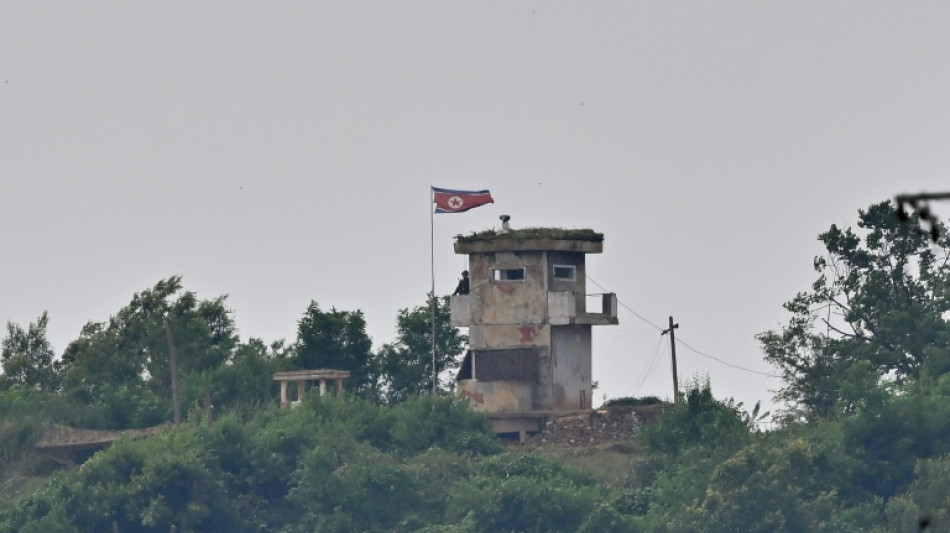
South Korea demands North apologise for DMZ mine blasts / Photo: Jung Yeon-je - AFP
 10°C
10°C

Seoul's military demanded an apology from North Korea on Wednesday, blaming them for a recent explosion in the demilitarised zone that severely injured three South Korean soldiers, a charge Pyongyang denies.
Seoul and Pyongyang remain technically at war since the 1950-53 Korean War ended in a truce, not a peace treaty.
Three South Korean officers were severely injured in the September 21 explosion inside the Demilitarised Zone (DMZ), the heavily mined buffer dividing the two Koreas since their 1953 armistice. One lost his foot.
On September 21, "South Korean soldiers sustained serious injuries from North Korean landmines while conducting normal search operations south of the Military Demarcation Line," Kang Hyun-woo, chief director of operations of Seoul's Joint Chiefs of Staff, told reporters.
"This is a clear violation of the Armistice Agreement and undermines the spirit of existing inter-Korean agreements; it must be stopped immediately," he said, adding "we strongly urge an apology and responsible measures."
Kang glared into the camera as he read the statement aloud in a raised voice.
Hours earlier, the powerful sister of North Korean leader Kim Jong Un had denied North Korea was behind the landmine blasts.
South Korea's assertion is "too low and dirty as befitting the tribes of the ROK," Kim Yo Jong, said in a statement carried by state news agency KCNA, using the South's formal name, the Republic of Korea.
The United Nations Command said Wednesday a joint investigation with Seoul's military had "identified an active Democratic People's Republic of Korea (North Korea's) anti-personnel mine on the ROK side of the Military Demarcation Line."
"Based on the findings of the investigation, UNC determined that an Armistice Agreement violation occurred," it added, reiterating what Seoul said a day earlier.
The United Nations Command is a US-led multinational military force charged with overseeing the armistice agreement that halted fighting in the Korean War and administers the southern side of the DMZ.
Landmine incidents on the DMZ, one of the world's most heavily fortified frontiers, have previously heightened tensions between the two Koreas.
After an investigation into the September 21 incident, South Korea's defence minister Kang Shin-chul said its military "has a range of necessary measures at our disposal, and we will implement them in stages", without giving details.
The North Korean mines were believed to have been laid as part of Pyongyang's border fortification work, minister Kang said Tuesday.
The border fortification work has led North Korean soldiers to accidentally cross the land border in the past, according to Seoul's military.
But Kim Yo Jong said the South was "cooking up" bogus allegations as a pretext for political and military provocation against North Korea, KCNA said.
"Clearly speaking, our soldiers have never crossed the border," she added.
"We will never remain a passive onlooker to the hostile acts causing great concern in the border area."
- Loudspeaker broadcasts -
Since 2024, after North Korean leader Kim Jong Un designated South Korea as his country's "principal enemy," Pyongyang's military has laid mines and built anti-tank barriers along the frontier as part of efforts to permanently seal it off.
During the operation, Pyongyang also blew up the northern parts of inter-Korean roads no longer in use.
In a 2015 incident, two South Korean soldiers were seriously wounded in a landmine blast on the southern side of the DMZ, with one losing both legs.
Seoul concluded that North Korean troops had crossed the Military Demarcation Line to plant the mines, an accusation Pyongyang denied.
That incident prompted South Korea to resume anti-Pyongyang loudspeaker broadcasts along the border.
With the latest developments, "I do not think the possibility of a military provocation can be ruled out," Lee Ho-ryung of the Korea Institute for Defense Analyses, told AFP.
"Pyongyang has repeatedly referred to the border and may seek to demonstrate in some tangible way what it means by its newly defined hostility toward South Korea."
S.Schuster--MP