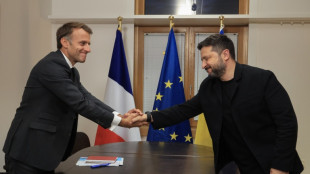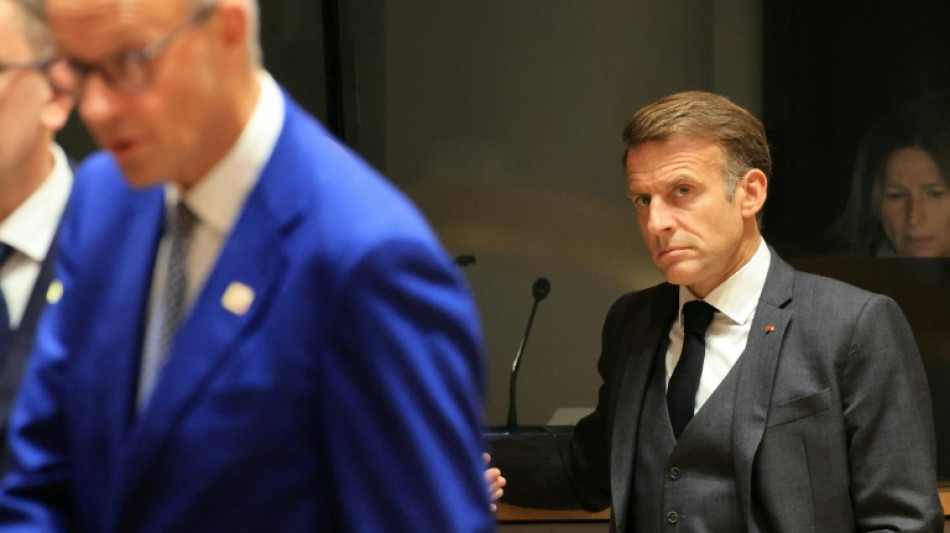
Macron warns urgent to strike EU budget deal before French vote runup / Photo: Ludovic MARIN - AFP

French President Emmanuel Macron Thursday urged his EU counterparts to seal a deal on a long-term budget by Christmas, warning it will grow much harder in the runup to high-stakes 2027 elections in France and elsewhere in Europe.
The 27-country European Union is in a race against time on the spending plan, worried any future dealmaking will be derailed by potential eurosceptic wins -- most crucially in key power France where the far right's Marine Le Pen is running in the lead.
Macron said agreeing a deal would be "complicated in between January to April because of elections", one European diplomat told AFP.
Another diplomat said Macron told fellow leaders in Brussels there would be "no political breathing room from January onwards" for an agreement.
A third said the French delegation specifically raised the elections in France during the nearly four hours of talks on the budget.
There was little sign of progress after the day's meeting, with leaders watering down their conclusions to call for a "timely agreement" rather than setting a hard year-end deadline.
But an EU official said all member states backed the goal of an agreement before 2026 is out.
The nearly two-trillion-euro budget will determine the EU's main priorities for the period from 2028 to 2034, from agriculture and defence to competitiveness and migration.
Leaders must agree how much to give to farmers, what to spend on defence, how to make the economy more competitive against the United States and China, and whether to pour European money into migrant "return hubs" in Africa.
But there are deep divisions, and virtually all countries have come out against the latest proposal on the table.
"We are facing very, very difficult negotiations," Germany's Chancellor Friedrich Merz told reporters earlier Thursday.
Leaders are "still very far apart", he added, suggesting they "pack a few extra shirts" for a final summit meeting set for December.
- Spectre of Le Pen -
The sense of urgency is real, with elections looming in France but also in Italy, Poland, Greece and Finland -- and the awareness eurosceptic new governments could make it much harder to reach a 2027 deal.
Le Pen has already vowed to slash the country's contribution to the EU budget to help cost savings in the bloc's second-biggest economy.
Putting the screws on the EU, Le Pen travelled to Brussels on the eve of the summit to warn of a "democratic scandal" if leaders adopted a budget before France heads to the polls in April and May.
Ireland, which holds the rotating EU presidency, presented the latest proposal forming the basis of the talks, with cuts of around 140 billion euros to the budget total.
But as it stands, three opposing camps are all unhappy at what is on the table -- each for their own reasons.
- 'Far too expensive' -
On one side is Germany, leading a group known as the frugals that includes the Netherlands and Sweden, which demand cuts of several hundred billion euros.
In another corner is France, which opposes massive cuts to the budget and believes the continent needs a larger pot to match the rising challenges it faces.
A French official warned there could be no agreement without "substantial" new bloc-wide taxes including on large companies, environmental taxation and levies on tobacco.
Paris also wants EU-wide taxes on digital services, crypto-assets and online gambling, which the European Parliament also seeks.
And in the third camp are the "Friends of Cohesion", demanding more funding specifically to support agriculture and regional development.
"The proposal is clearly insufficient," said Spain's Pedro Sanchez, maintaining that the money on the table was "far short" of what was needed for the bloc to respond to the many challenges it faces.
European Council President Antonio Costa will lead negotiations in the countdown to December, with an extraordinary meeting added in late November to help get the budget over the line.
A.Kenny--MP