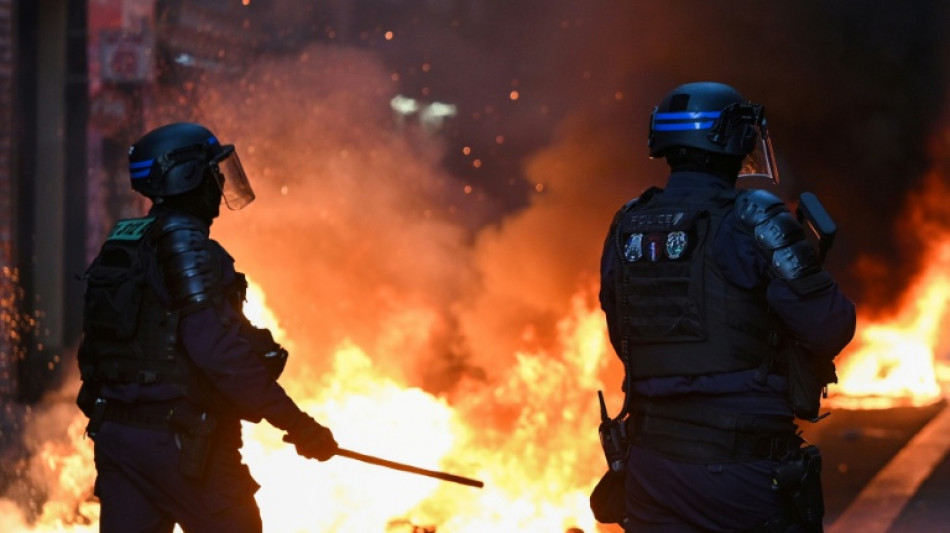
Around the world, far right blames immigrants for French protests / Photo: Matthieu RONDEL - AFP/File
Right-wing politicians around the world have seized on France's riots, casting immigration as the culprit ahead of tense elections testing their own populist credentials.
There has been no link between the violence -- which spilled over from cost-of-living protests -- and immigration, but the upheaval in France has become a favourite talking point for politicians in the United States, Spain and Israel.
France has been "conquered, looted and burned to the ground by migrants, jihadists and communists", Trump claimed at a rally ahead of crucial mid-term elections next month, part of repeated attempts by his administration to link Europe to America's own culture wars.
The leader of Spain's far-right Vox party, Santiago Abascal -- also jockeying for position ahead of elections in November -- warned of "Islamo-leftism" in a post showing a fire devouring the 19th-century city hall in the French city of Limoges.
French President Emmanuel Macron appeared to take aim Wednesday at Trump and Israeli Prime Minister Benjamin Netanyahu -- who claimed France had been hit by an "invasion of extremist Islam" -- by criticising "people who campaign at France's expense" and the "stupid comments by many, including foreign leaders".
Macron did not name names, but Trump's Republican party faces headwinds ahead of the November congressional elections, while Israel heads to the polls next week.
- Law-and-order Le Pen -
France's far-right presidential candidate Marine Le Pen, who is currently leading the polls for elections next year, has -- at least partially -- taken a different tack, casting herself as the law-and-order candidate.
The National Rally (RN) politician has not completely shied away from her preferred issue, saying France was "paying for decades of anarchic immigration".
But addressing cameras from a dark wood desk with a French flag behind her, she focused her attacks on the "impotence" of the outgoing government of President Emmanuel Macron.
She also accused the far-left France Unbowed (LFI) party, which has supported the protests, of trying to instigate a "civil war".
Le Pen has put herself firmly on the side of the police, as part of the post-riot conversation turns to security failures and restoring order ahead of more protests planned for this Saturday.
Le Pen "wants to appear as a future president, not only as the party that is against immigration" -- even if "everybody knows what they stand for", said Nonna Mayer, a research professor at France's Sciences Po.
Le Pen's reaction "fits a longer-running effort to present herself as a more credible governing figure", said Jess Middleton, senior Europe analyst at risk intelligence firm Verisk Maplecroft.
- 'Polarised society' -
Macron, who must step down after serving two consecutive terms, wondered how "French people do this to France", and blamed ultra-left fringe groups for the violence.
His housing minister, Vincent Jeanbrun, singled out "a small part of our working-class neighbourhoods" as the home of many of the perpetrators.
Among the crowds were "French citizens of immigrant backgrounds", political scientist Pascal Perrineau told AFP.
But they were just one sub-section of a variety of people involved in the violence, including students, demonstrators with revolutionary-style politics and radical "black bloc" protesters who often "advocate chaos in the streets".
Whoever wins the presidency will have to deal with the initial causes of the protests -- first led by students complaining of poor conditions at school, then widening into broader concerns over surging inflation.
Years of recurring, sometimes violent protests -- including by the anti-Macron, largely rural Yellow Vest movement -- reveal a France that is "deeply divided, in which there is an atmosphere prone to riots," said Perrineau, predicting an "extremely agitated" presidential election season.
Widespread anger has been building around high costs and poor public services, said Stephane Sirot, a historian of social movements.
The violence "illustrates the problems of a more and more polarised society".
H.Klein--MP