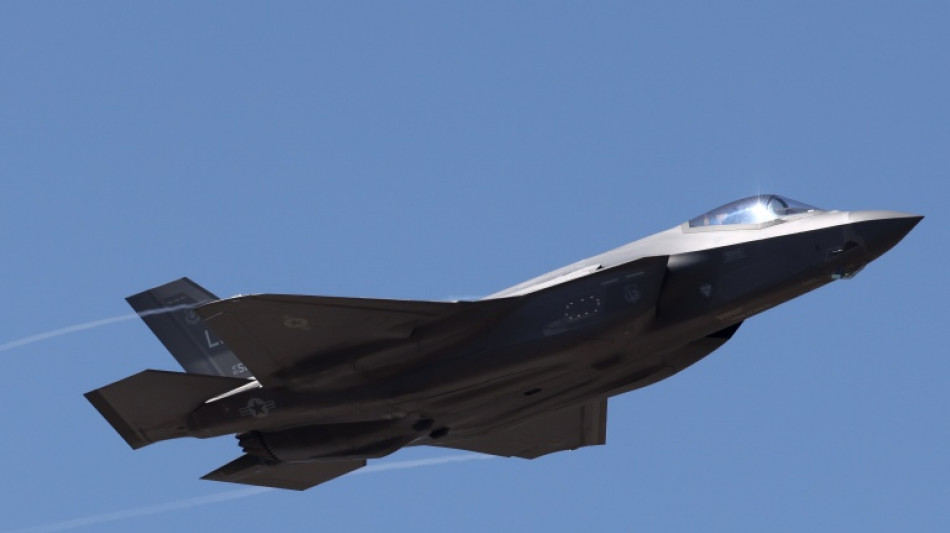
Pentagon, Lockheed announce agreement for 850 F-35 jets over 10 years / Photo: Toby Shepheard - AFP/File

The Pentagon and Lockheed Martin on Thursday announced a 10-year agreement for the production of 850 F-35 warplanes, underscoring Washington's long-term commitment to the high-tech stealth aircraft.
The two sides did not specify a value for the agreement, which comes as Pentagon seeks to strike multi-year deals to expand American weapons production and boost the US defense industrial base.
The announcement "cements (the plane's) role as the free world's key frontline fighter for years ahead," Lockheed Chairman, President and CEO Jim Taiclet said on a call with investors.
F-35s -- which Washington's forces have used in combat during the US-Israeli war against Iran -- come in three variants that can cost more than $100 million per plane.
The "framework agreement," which the Pentagon said would "modernize and expand" the F-35 program, still requires congressional approval and funding.
"We have fundamentally changed how we stabilize the American defense industrial base to produce at speed and scale," top acquisition official Michael Duffey said in the Pentagon's announcement.
"By aligning financial incentives with actual performance, we are ensuring our warfighters are equipped with the lethal capabilities they need to fight and win," Duffy said.
The F-35, a joint project between the United States and a number of allies, is one of the world's most advanced military aircraft. There are more than 1,375 F-35s based around the world, according to Lockheed.
The deal, if approved, would give Washington a "predictable, affordable, and resilient" fighter jet program, Lockheed said, pointing to billions of dollars in expected savings thanks to "long-term pricing and industry volume discounts."
- 'Greater certainty' -
In exchange for the Pentagon's 10-year commitment, Lockheed Martin will fund $7 billion in projects supporting the F-35s, the Pentagon said.
"With the greater certainty that comes from the US government's transformative approach to F-35 production and sustainment, we can make the upfront investments needed to expand capacity, improve efficiency, and build a more resilient supply chain," Lockheed's Taiclet said in a statement.
"That's good for the taxpayer, good for our suppliers and, most importantly, good for the United States and its allies," he added.
Lockheed pledged to produce the warplanes at a rate of 156 aircraft per year.
In addition to the F-35s themselves, the agreement also covers "initial spares, 10 years of modification kits and sustainment, and international customer orders," Lockheed said.
There is significant international interest in the aircraft, with the United States recently announcing the approval of a $24.3 billion sale of 48 of the stealth planes to Saudi Arabia last month.
Turkey, which was expelled from the F-35 program in 2019 over its purchase of a Russian air defense system, recently expressed confidence that it would regain access to the jets -- a move that is however strongly opposed by Israel.
Lockheed said the F-35 program will support more than 315,000 jobs and generate nearly $80 billion in economic activity in the next 10 years, "strengthening the nation's industrial base and providing long-term stability for suppliers."
The company on Thursday announced better-than-expected earnings for the third quarter, once again benefiting from higher activity levels across all of its segments.
D.Johannsen--MP