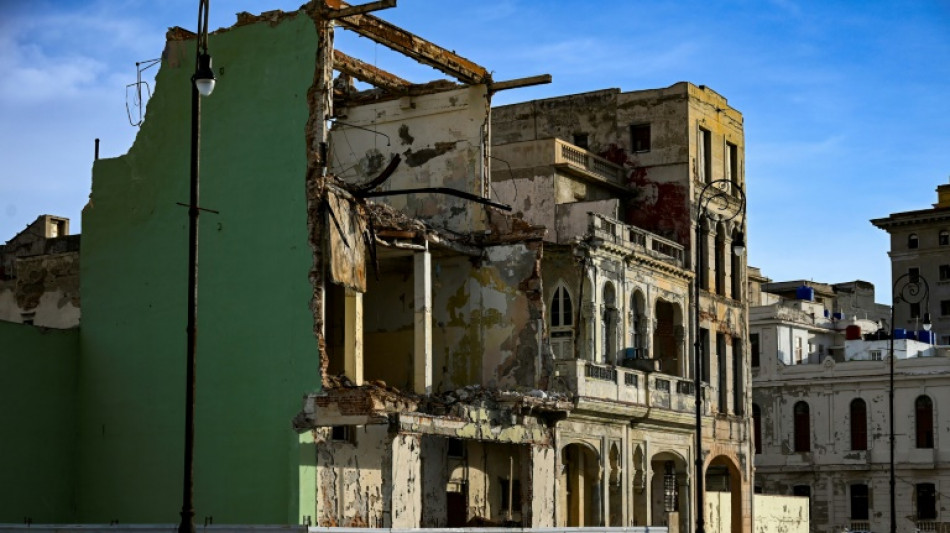
Cuba's historic homes teeter on brink as economy collapses / Photo: YAMIL LAGE - AFP
 11°C
11°C
In Havana's old town, to walk on the pavement rather than the middle of the street is to take your life into your hands.
The ornate stone balconies of the decaying colonial townhouses jutting above your head are liable to collapse at any moment.
Tens of thousands of people housed in these monuments to pre-revolutionary Cuba, which were subdivided into apartments after Fidel Castro took power in 1959, live on the edge, literally.
In the densely populated Centro Habana district, a storm brought down the stone staircase, leading from the ground to the upper floors, in the neo-classical pink 1920s tenement where Marnie Estevez lives.
Estevez, her husband, two daughters, mother and 97-year-old grandmother were left perched on the third floor, with no way out.
"The fire service had to come and get my grandmother down with a crane," Estevez told AFP in the tiny two-roomed apartment that she, her husband and children have moved into on the first floor.
Her mother and grandmother are still living in a hostel seven years later -- just two of the many thousands of people evacuated from ruined buildings to cramped temporary lodgings.
In nearby Habana Vieja, the historic city center, nine families who decamped from a collapsed building three years ago are still living in a boxing gym.
Each family lives between four walls of cardboard surrounded by sheets held up by wires and sticks for privacy.
With Cuba's economy buckling five months into a US-imposed fuel blockade, and the national housing deficit running to over 900,000 units, authorities say a quick fix is unlikely.
"It looks very difficult, given the situation," said Dayana Garcia, a mother who is raising three children in the gym.
- 'No money to fix anything' -
Across Havana, the ravages of time, lack of maintenance and overcrowding is writ large in the facades of one of the best preserved colonial cities in the Americas.
Habana Vieja, a UNESCO World Heritage Site, is home to around 900 listed buildings, some dating back to the early years of Spanish rule in the 16th century.
But in some cases, blue skies can be seen through the facades, making the decaying structures look like theater props.
Between 2000 and 2013, a total of 3,856 buildings collapsed -- nearly one a day -- according to the Office of the City Historian, which is responsible for maintaining listed buildings.
By 2020, around 37 percent of the country's residential buildings were deemed unsafe.
"Havana is falling down," Estevez's 64-year-old mother Leodiska Canino said flatly.
"There is no money here to fix anything," she added.
In the gym, electrical wires snake across the floor to each family's cardboard home, but there is no running water and the heat under the zinc roof is stifling.
The thud of fists walloping punching bags reverberates through the gym from morning until evening.
"This is not a life," one of the relocated mothers grumbled.
- An absent government -
The fortunes of Havana's colonial buildings mirror that of the nearly seven-decade-old revolution, their peeling pastel-colored facades are symbols of the repeated crises that have rocked the island, and its surprising resilience.
Some buildings were spruced up as part of a tourism drive launched in the 1990s, which peaked in the years following the landmark 2016 visit by former US President Barack Obama.
In others, like the one in which Estevez lives, the balconies and upper floors are propped up by wooden stilts.
The 43-year-old, who minds children and elderly people for a living, tries her best to patch up her apartment but worries about the cracks in the walls.
Garcia, the 35-year-old mother living in the gym, is concerned for the health of her children, one of whom has developed a lung infection because of exposure to damp.
She bitterly accuses Cuba's communist authorities of abandoning them to their fate.
"Nobody from the government comes here...not even to see how we are, if we're alive or dead."
A.Meyer--MP