How narwhal 'scientists' track Arctic warming / Photo: The Greenland Institute of Natural Resources - Handout/AFP
 22°C
22°C

The fight against climate change has a new, spiral-tusked ally: the narwhal.
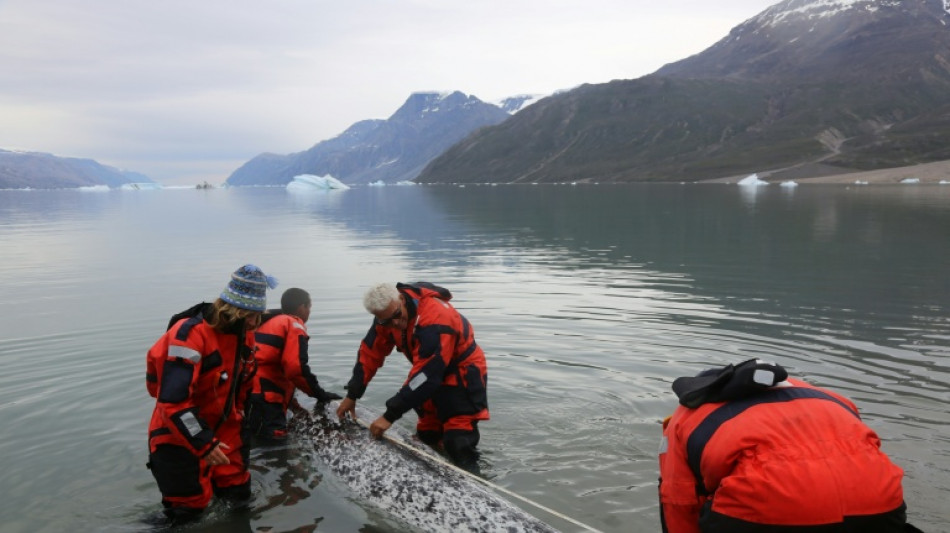
In a study published in Science Advances on Wednesday, researchers equipped six of the toothed whales, sometimes called "unicorns of the sea," with satellite transmitters, and had them explore remote East Greenland waters.
From 2017-2020, these "unconventional collaborators" retrieved more than 2,000 invaluable observations of temperature and salinity that helped show how warm Atlantic water is penetrating deep into the region's fjords and intensifying glacial melt, which in turn has impacts for critical global weather systems.
"We have used a completely novel technique," Mads Peter Heide-Jorgensen, a professor at the Greenland Institute of Natural Resources and first author of the paper, told AFP.
With the narwhals plumbing the cold depths of the Arctic ocean, "we can sit at our warm offices and drink coffee while the data comes in," he added.
- Global climate consequences -
Freshwater from melting glaciers in East Greenland's spectacular fjords and its coastal shelf contribute to two major Arctic currents.
One of these, the East Greenland Current, is a key regulator of the Atlantic Meridional Overturning Circulation (AMOC), a massive conveyer belt of ocean currents.
Scientists believe if the AMOC eventually collapses, it could trigger profound cooling during Europe's winters, plunging the continent into deep freezes.
It is therefore imperative to better understand the impact of "Atlantification" of East Greenland waters, but the remote, harsh environment has made it costly and difficult for researchers to reach the area.
Traditionally, measurements were performed by crews on ships who would sample water columns for data on salinity, said Heide-Jorgensen.
More recently, it has been possible to set up electronic sensors, but that has normally been confined to summer when the waters are open.
Icebreaker ships are relatively few and they are prohibitively expensive.
Their crews are at risk if the ships are damaged, and the vessels could capsize if they are in the vicinity of giant ice chunks breaking off glaciers, a process called calving.
The narwhals, on the other hand, proved themselves adept scientists.
Diving to depths of more than 1,500 meters (4,900 feet), they could sample entire water columns, taking readings of temperature and salinity as well as depth and position that were then converted into a measure of potential density.
Depending on this density, the water was determined to be either Atlantic or polar in origin.
One of their key findings was that Atlantic-origin water was detected deep beneath glaciers located in the Scoresby Sound fjord complex, 350 kilometers (220 miles) inland.
- Capable, but reluctant -
While scientists have in the past tried employing other marine mammals, including seals, beluga and bowhead whales, narwhals have the distinct advantage of returning to the same spots, invaluable for collecting repeated measurements over time as required by science.
The team grew attached to their collaborators and gave them old Nordic names like Freya and Balder (though they weren't listed as co-authors).
Not that the admiration ran both ways.
"I wouldn't say they enjoy interacting with humans," reflected Heide-Jorgensen, noting "they do it under protest."
Catching them in nets and fitting the instruments takes about 20 minutes: a brief stressful episode after which the animals return to normal behavior. The tags eventually fall off on their own.
The authors enthused that the partnership "showcased how innovative approaches, even involving unconventional collaborators, can revolutionize oceanographic research."
But narwhals are themselves "losers in the climate game," noted Heide-Jorgensen.
A warming climate is reducing their habitat and it is predicted they'll have to eventually move further north to maintain proximity to cold water.
J.P.Hofmann--MP