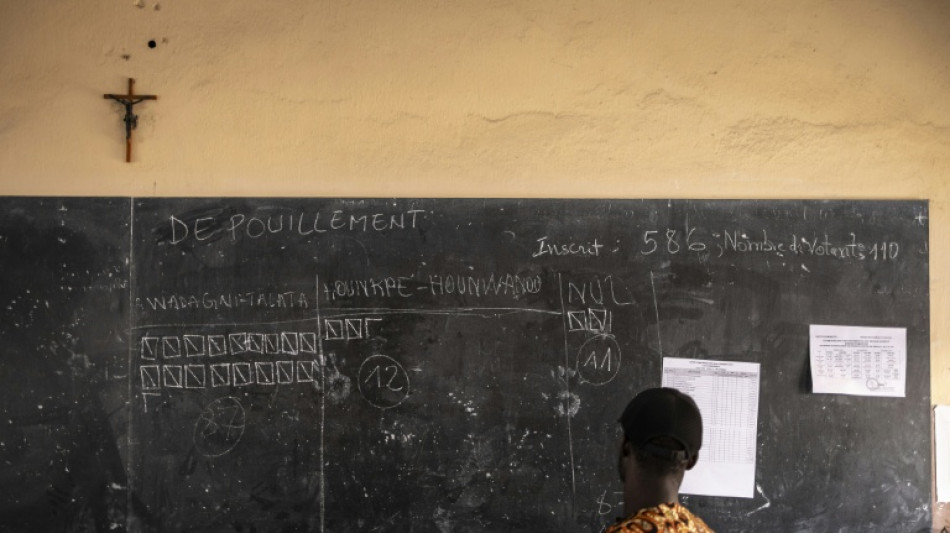
Opposition candidate concedes defeat in Benin presidential election / Photo: OLYMPIA DE MAISMONT - AFP

Benin presidential election favourite Romuald Wadagni was on course for victory Monday as his opponent conceded defeat even as votes were still being counted.
Opposition candidate Paul Hounkpe offered "republican congratulations" to Wadagni, who had been widely tipped to win after being endorsed by outgoing leader Patrice Talon.
Official results are expected not before Tuesday, but Wadagni's ability to conjure economic growth in the face of jihadist attacks gave him a clear lead, even if the eight million-strong electorate showed scant enthusiasm for either choice before them, notably in the cities.
In the capital Porto-Novo, turnout for Sunday's vote ranged from just 20 to 40 percent at some polling stations, while life in economic capital Cotonou was largely back to its usual bustle by midday on Monday, an AFP journalist observed.
Hounkpe ran a low-key campaign and needed the help of majority lawmakers to secure the required parliamentary endorsements even to get on the ballot paper.
The main opposition The Democrats party did not field a candidate as its leader, Renaud Agbodjo, failed to secure sufficient endorsements.
For the media, in the words of Le Telegramme daily, the election was "generally calm and well-organised," while Le Matin Libre saw "Wadagni on his way to the Marina," the presidential palace.
Le Patriote, however, saw "signs of an electoral heist."
"We are waiting for the CENA (electoral commission) to confirm in the coming hours what we already knew: the undisputed victory of our candidate," said Rominus Gnonlonfoun, a leading Wadagni supporter.
- Challenges ahead -
Jean de Dieu Hadjinou, a member of Hounkpe's party, said he did not trust "either social media or the premature celebrations of a camp that is already claiming victory."
For Alimata, a lock seller in the Gbegemey neighbourhood, "if this election or Wadagni's arrival can change our lives, we shall be happy but for now, we have to find a way to feed the family.
Earlier Monday, the Economic Community of West African States (ECOWAS) election observation mission praised "a peaceful atmosphere" and "the smooth running of the election."
Wadagni embodied continuity with the Talon era, which has seen Benin enjoy rapid economic growth, an expansion in tourism and the completion of numerous infrastructure projects.
But major challenges remain, including a huge gap between the haves and the have-nots in a country where the poverty rate is estimated at more than 30 percent, and many feel they have not felt the benefits of economic growth.
Benin's economic growth will also depend on security, with the country's north plagued by increasingly deadly jihadist violence, carried out mainly by Al-Qaeda's Sahel branch, the Group for the Support of Islam and Muslims (JNIM).
The next elections are not until 2033, as a constitutional reform passed last year has extended the presidential term from five years to seven and synchronised all elections to take place then.
P.Mueller--MP